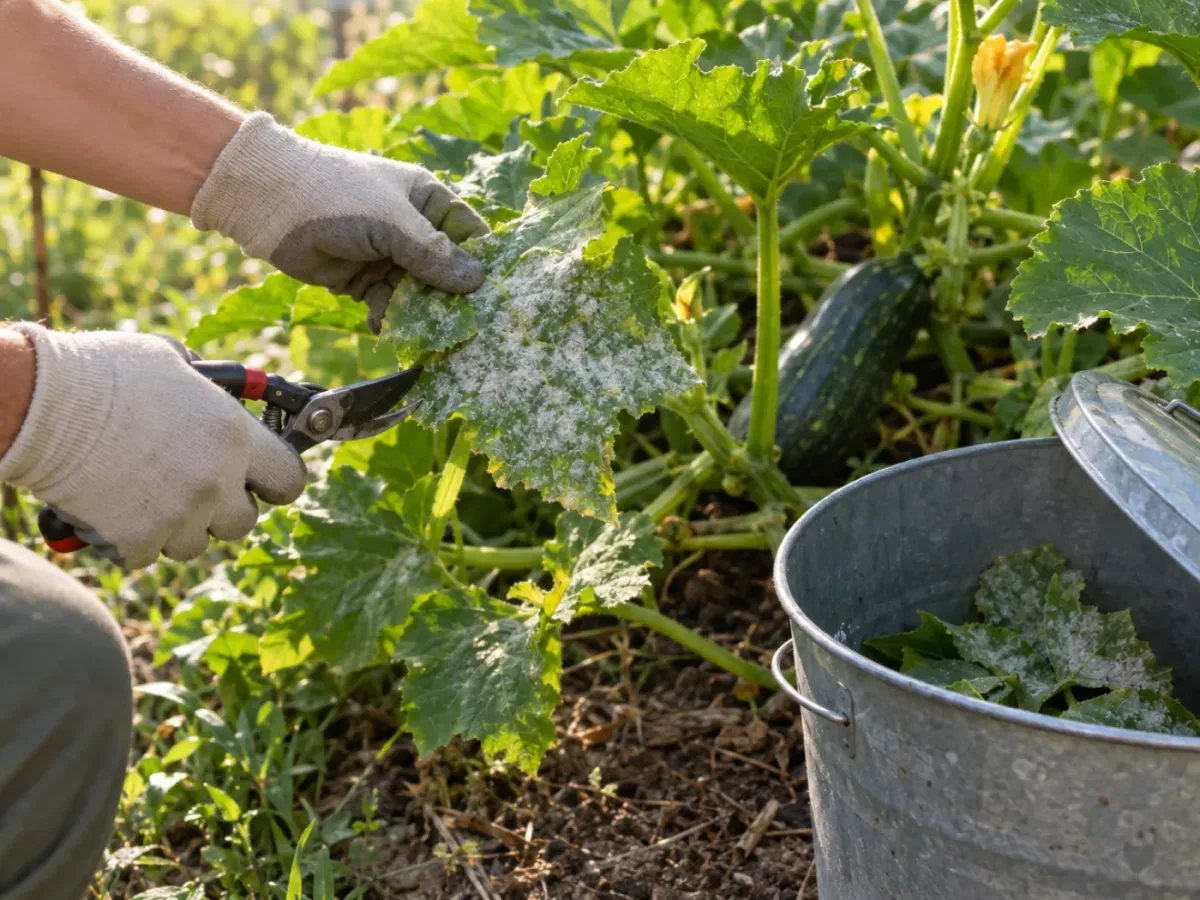
Your squash leaves lost a flour fight
White powder on the squash patch in November, plus little black specks? We have good news: the fix is mostly free.
What you're looking at
Penn State's extension describes powdery mildew as looking like flour dusted on leaf surfaces, and in the fall, round black specks can form in the white patches. Those specks are cleistothecia, the fungus's fruiting bodies. Penn State says the fungus can survive the winter attached to plants and debris, and new outbreaks sometimes come from dormant spores in old plant material or weeds. Crowded, shady, poorly ventilated spots get hit hardest.
The gentlest fix first
Start cultural, per Penn State: remove infected leaves, branches, flowers, or fruits, and dispose of them in a closed container or by burning, never the compost, because most home piles don't run hot enough to kill spores. Sterilize tools between plants and clear fall debris, since the fungus persists on it. Prevention beats cure: stake or prune for airflow, avoid crowding and overwatering, water at the soil level or early in the morning, and pick resistant cultivars. South Dakota State's cleanup rule: bag diseased debris for the trash, and don't save seeds from diseased plants. Fungicides have limitations and aren't guaranteed, per Penn State; follow the label and ask your local extension office.
Your zone
- Zones 3-4: South Dakota State's extension warns powdery mildew on squash spreads rapidly into the fall, so discard infected foliage at season's end.
- Zones 5-6: Penn State's extension says start with airflow, pruning, and removing infected leaves before reaching for a fungicide.
- Zones 9-10: Alameda County's UC master gardeners advise clearing spent squash to prevent disease carryover and keeping diseased plants out of compost.
Bottom line
- Flour dust plus late-season black specks on squash is powdery mildew, which overwinters on debris.
- Remove infected material, trash it in a closed container, never compost it, and sanitize your tools.
- Fungicides are a limited, last-resort tool, not a first move.
Sources
- "Fall Garden Cleanup," SDSU Extension, https://extension.sdstate.edu/fall-garden-cleanup, updated Oct 19, 2026
- "Addressing Downy Mildew and Powdery Mildew in the Home Garden," Penn State Extension, https://extension.psu.edu/addressing-downy-mildew-and-powdery-mildew-in-the-home-garden, updated June 8, 2026
- "Fall & Winter Gardening Checklist for the San Francisco Bay Area," UC ANR Master Gardeners of Alameda County, https://ucanr.edu/blog/over-fence-alameda-county/article/fall-winter-gardening-checklist-san-francisco-bay-area, Nov 2, 2025
- "South Florida Gardening Calendar (ENH1191)," UF/IFAS Extension, https://ask.ifas.ufl.edu/publication/EP452/pdf, revised October 2024
This week: bag every flour-dusted leaf and walk it to the trash, not the compost.
Photo: generated with AI.
